No items found.



A Playbook for Building AI-Native Leadership Teams
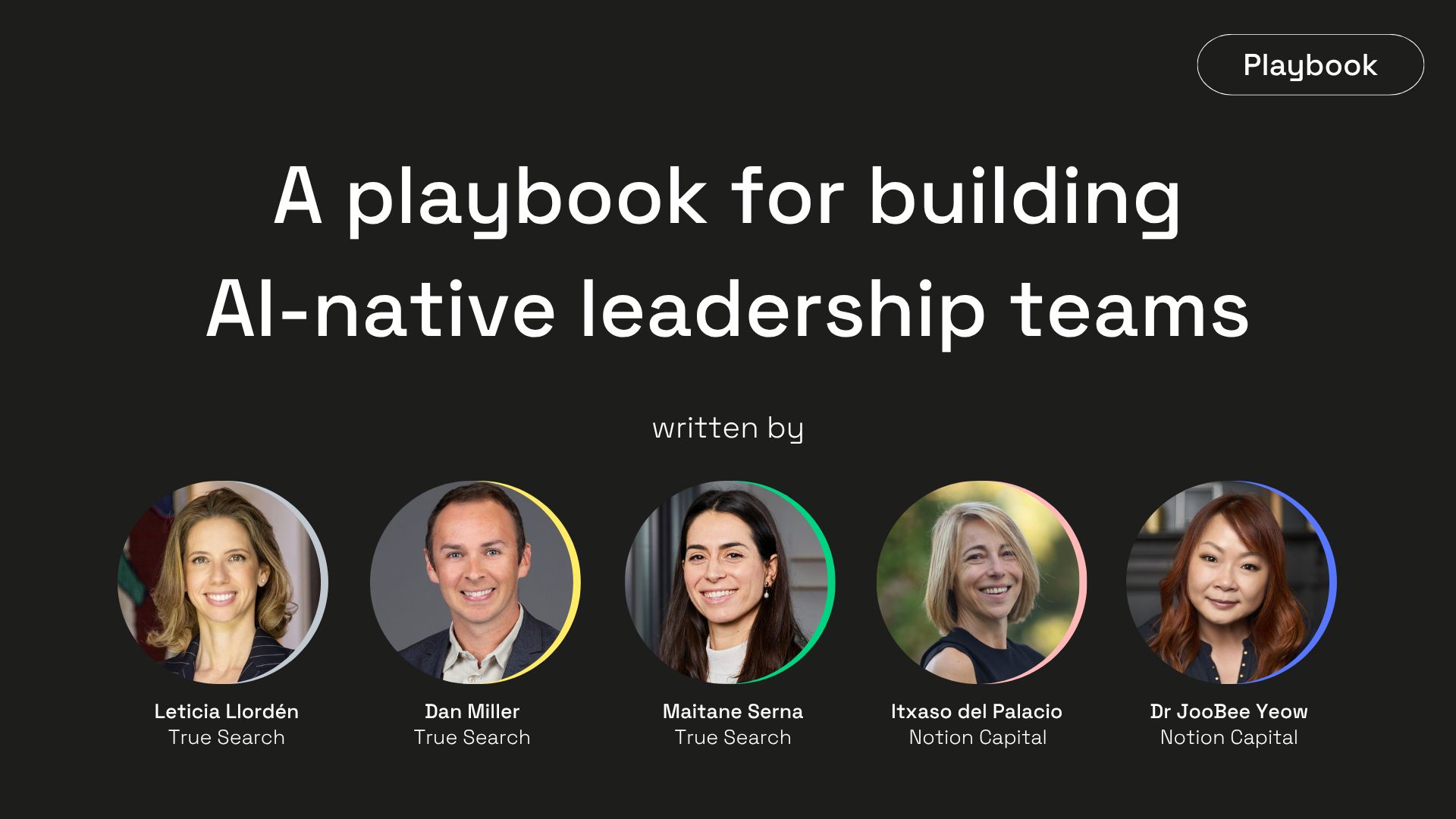


AI-native companies operate under different rules than tech businesses of the pre-AI era. They face compressed timelines, flattened organizational charts, and a new definition of what "great" performance looks like, while also operating with extreme lean efficiency where multidisciplinary teams use AI to outpace massive legacy organizations.
This guide, a collaboration between True and Notion Capital, outlines the leadership frameworks that separate AI-native winners from teams that waste capital chasing shiny new products. The hardest part isn't the AI itself. The real challenge is building a team that can turn that technology into a sustainable business through smart distribution and a strong brand.
The Leadership Roles AI-Native Companies Actually Need
In AI-native companies, hiring senior leaders across functions all at once speeds up failure. The cost structure and technical uncertainty of AI require a disciplined sequence.
Months 0–12: The Builders
The first phase focuses on proving the technology works and solving a real-world problem. Two roles come first.
- A Head of Product, or a technical co-founder with an AI-first mindset, takes priority. This leader must have great founder-market fit with a deep understanding of market intrinsics. They know exactly what customers need and what they will actually pay for, and manage the user feedback loop to ensure AI solves a high-value problem. This person uses AI to iterate directly on the product code and prompt architecture.
- A VP of Engineering or Chief Technology Officer (CTO) comes next, often at the same time as the co-founder. This person manages the economics of your AI, balancing API costs against customer value, and builds scalable infrastructure, including MLOps. Without this attention early on, GPU costs can consume runway before product-market fit.
Months 12-18: The Validators
Once the product stabilizes, the goal shifts to proving that customers will pay and the business model works.
- A GTM Lead, like a Head of Sales or Growth, transitions the company from founder-led sales to a professional GTM engine, prioritizing sales before marketing and growth. They should be a player-coach who can close the first 20 deals and identify where revenue starts generating. This leader must also navigate the pricing tension between seat-based models that risk negative margins for AI-native companies and usage-based models that enterprises find unpredictable.
- A Finance Lead, like a VP of Finance or a Fractional CFO, becomes important before a Series B. AI companies have unique costs due to infrastructure and inference demands. Accurate runway modeling requires expertise in these areas and in many early-stage teams, this person also handles operations.
Months 18-24: The Scalers
With validation achieved, the focus turns to standardizing operations and preparing for expansion.
- A VP of Marketing or Head of User Acquisition drives brand reach and lead generation once it’s clear who buys and why, focusing on brand authority and top-of-funnel traction.
- A VP of Talent or People anticipates talent needs, shapes corporate culture, and advises on organizational design. With increasing automation, they must structure the workforce to integrate AI-native talent with those adapting from pre-AI environments.
- A Head of AI Ethics and Compliance becomes important for companies in regulated sectors like fintech, telecom, and healthcare. They can’t scale without understanding the EU AI Act and data privacy rules. In sensitive sectors, this hire may need to come sooner.
Technical Leaders: Who to Hire When?
The Leadership Profile That Wins in AI
The best leaders can shift between different operational styles, depending on the stage of business. They are warriors who drive action, thinkers who pause to analyze, mentors who inspire and support others, and visionaries who challenge assumptions. Most leaders, however, are strong in some areas while needing development in others.
Successful companies design complementary C-suites that cover each other's gaps, with diversity in styles of communication, decision-making, and stress management. While this approach will take more effort and intention to achieve alignment, the eventual payoff is significant. The True AI Capability Index is the only reliable system that surfaces executives with this winning combination of proven execution and AI fluency to help clients derisk every leadership hire.
AI talent also extends beyond executives to include advisors, sometimes on an interim or fractional basis, or an AI-experienced board member.
Hiring for Potential in a World That Moves Too Fast
Hiring for future potential is increasingly important because past experience quickly loses its relevance when the landscape evolves as fast as it does today. What truly matters is a candidate's ability to learn, adapt, and improve at speed.
The most effective leadership profiles share a common set of traits:
- Extreme self-awareness and a constant drive to improve
- A leaning toward action paired with a willingness to iterate quickly
- High coachability and openness for feedback
- The ability to recover quickly from failure and re-engage with enthusiasm
Some founders successfully hire from unconventional talent pools. One founder in True’s network produced strong results hiring former high-performance athletes who brought ingrained discipline and determination. They also brought high comfort with failure, an essential skill for the age of AI where companies must pivot according to model results or market shifts.
Helping Disruptors Win
A leader hired for their innovative vision cannot fulfill their mandate without full support and buy-in from the board and the rest of the C-suite. Conventional methods of developing unconventional talent (e.g. structured development plans, fixed pathways, and long-term competency models), no longer hold up in a future that is constantly evolving.
The focus needs to shift to building a system that helps high-potential leaders self identify, access, and act on what they need quickly. That system needs 3 things:
- Insight: Fast feedback loops and high-context exposure so they can understand what is changing, where they need to grow, and align what the business needs from them next.
- Support: Access to role models, mentors, and leaders who can help them make sense of complexity, not just follow a prescribed path.
- Experience: Exposure to cross-functional business challenges so they can build judgement, adaptability, and commercial understanding in real time.
Retention in the AI Talent War
Attracting talent is no longer enough. Retaining it has become equally complex. Compensation still matters, especially as demand for AI expertise drives up market rates, but the differentiators increasingly sit elsewhere.
The most effective retention strategies focus on:
- Ownership through equity and meaningful participation in outcomes
- Purpose, creating a mission that extends beyond financial incentives
- Growth, offering continuous learning and development opportunities
- Leadership quality, as founders and chief executives set the tone for the entire organization
Culture Under Pressure
AI-native environments accelerate learning and attract curious, driven individuals, but introduces new risks.
How AI reshapes team dynamics:
- Smaller teams can now disrupt established players, creating opportunities that didn’t exist a decade ago.
- Critical thinking grows more valuable as AI takes over routine tasks and the real edge lies in reasoning and validating AI output.
- Lean structures speed up communication and decisions. Fewer engineers can now launch and scale meaningful products.
- AI-assisted hiring and onboarding compress timelines further.
- The pace of AI is driving a trend for back-to-office, where proximity enables rapid problem-solving, team cohesion, and real-time idea generation.
- Training becomes a key advantage and companies that invest in development for coachable employees will outpace competitors.
The risks you cannot ignore:
- Fast change and new tools create gaps where people can fall behind.
- Individual work habits increase as colleagues rely on AI more than one another.
- Using AI requires critical judgment and problem-solving skills. Leaders must monitor how less experienced employees use these tools and catch errors early.
- Trust is harder to build at high speed and leaders must stay alert to new developments while staying present with their teams.
- AI use in recruiting introduces new problems. Fake resumes, automated interviews, and misrepresented skills make assessing technical abilities harder. Companies must rethink assessment and place greater emphasis on work samples, deep technical evaluations, real world simulations, and high quality references.
- Founders must combine drive with awareness, staying both focused and open to pivot.
Governance must also evolve accordingly. At True, we’re seeing a growing need for AI expertise at the board level, either through advisors or non-executive directors. This reflects the widening gap between companies that just "use AI" and those that are truly AI-native.
Closing Thoughts
AI is redefining not just how companies build products, but how they build teams, with the highest-performing organizations adopting a new approach: they hire fewer people with greater precision, prioritize adaptability over experience, design teams intentionally rather than incrementally, and treat culture as a system, not a byproduct.
Similiar
Articles
you also may like to read
Similar
Articles
you also may like to read




Get the latest from Notion Capital. Sign up to our newsletter.
Keep the conversation going:
LinkedIn
