No items found.



Practical insights on how AI is removing the constraints that shaped how GTM was designed and executed.

The challenge every GTM team is facing is understanding what AI strategies are genuinely working and what are simply generating attention. To explore that question, Notion Capital hosted a workshop with Harrison Rose, former co-founder of Paddle and now CEO of GoodFit, together with Al Simpson, Head of Marketing at GoodFit, and Even Walser, former CRO of GoCardless and now founder of Layer.
The objective was simple: discuss the practical applications of AI in GTM that are delivering value today, together with GTM experts and leaders from across our portfolio.
The discussion ranged from data foundations and experimentation through to forecasting, customer understanding, decision-making and execution.
Many organisations are still focused on improving existing processes. The more interesting examples pointed towards something more significant. AI is beginning to remove many of the constraints that shaped how modern go-to-market was designed in the first place.
The organisations making the most progress are not using AI simply to replace manual work. They are using it to make better decisions, run more experiments, understand customers more deeply and rethink how go-to-market should operate.
- Make Your Business Readable
The prerequisite for effective AI deployment is making the business readable.
This starts with comprehensive access to data: Sales calls, CRM records, customer interactions and operational data all need to be captured, structured and accessible. But data alone is not enough, context matters just as much.
That context includes positioning documents, product documentation, operating models, sales processes and clear definitions of how the business works. The goal is to give AI enough context to interpret information correctly.
Think of this as a progression from a system of record, to a system of context, and ultimately to a system of action. - Even Walser
The practical implication is that GTM leaders are not op treating AI readiness as a data project alone. The objective is to make the business executable by AI.
That means capturing not just what happened, but how the company wants work to be done: messaging, qualification standards, buyer personas, discovery processes, objection handling, approval rules and coaching principles.
Once that context is structured, it can move from documentation into workflow. It can support reps before calls, guide them during conversations, automate follow-up afterwards and give managers a consistent view of execution quality.
The businesses making the most progress have invested heavily in creating shared context, assigning ownership and ensuring that AI can access the same information as their teams. They have also recognised that this is not a one-off exercise. Context requires maintenance, ownership and accountability.
The objective is simple: make everything in the business readable by AI while ensuring everyone is working from the same underlying context and information. - Al Simpson.
From AI-Readable To AI-Actionable
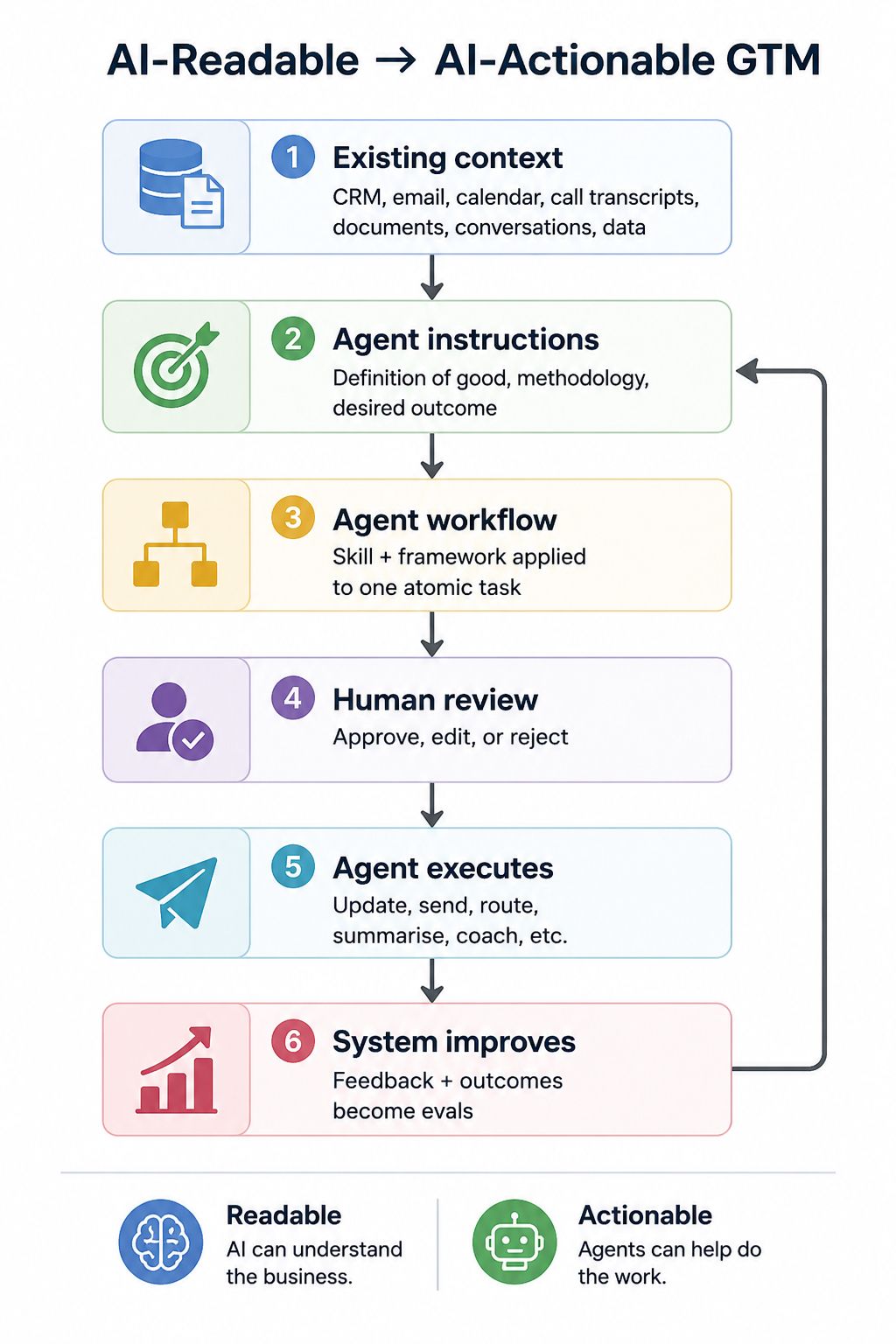
GoodFit’s example shows how to make a business readable by AI. The next step is making it actionable by agents.
A useful agent workflow needs four things:
- Definition of good
- Definition of outcome
- Workflow
- Human review and feedback
The agent prepares outputs inside the tools teams already use. Humans review, approve or edit. Those actions, along with outcomes, become evaluation signals that improve the agent over time. - Even Walser.
The Biggest Wins Start Inside The Business
Much of the public conversation around AI focuses on customer-facing applications. This discussion suggested the greatest value is being created internally.
Managers are reviewing more calls, analysing more opportunities and inspecting more pipeline than was previously possible. Forecasting, coaching and performance analysis are becoming more scalable because large volumes of information that once sat untouched can now be analysed quickly and consistently.
The result is not necessarily fewer managers, but is certainly the path to more capable managers. More leverage, greater span of control, better coaching coverage and deeper inspection.
One example discussed was call coaching. AI can identify which calls require attention and highlight the moments most worth reviewing. The important caveat is that these systems must be trained against expert human judgement before they are trusted at scale.
The management roles don’t go away. We simply get more leverage from the ones we already have. - Even Walser.
The most useful applications are not generic copilots. They are context-aware agents working inside specific GTM workflows.
A good GTM agent should know the account, the opportunity, the buyer persona, the company’s positioning, the current stage, the required next step and the manager’s standard for what good looks like.
That is what turns AI from a productivity tool into an operating layer.
The same principle extends beyond coaching. Revenue leaders can investigate pipeline trends, test assumptions, identify anomalies and analyse performance with a level of depth that was previously impractical.
AI Unleashes Experimentation
Historically, commercial experimentation has been constrained less by ideas than by the ability to execute. Testing a new outreach sequence, call cadence or routing strategy often required CRM changes, RevOps support, manual analysis and significant coordination.
The economics of experimentation change dramatically when much of the operational overhead disappears. - Harrison Rose.
At GoodFit, experiments that would previously have required multiple teams and weeks of effort can now be designed, executed and analysed through AI-enabled workflows.
If experimentation becomes dramatically cheaper, organisations can run more tests, learn faster and improve more quickly. Experiments that were previously too small to justify suddenly become viable.
The bottleneck is no longer running the experiment. The bottleneck is coming up with a good hypothesis. - Al Simpson.
The same principles can be applied to messaging, segmentation, channel selection, lead routing and a wide range of operational decisions that historically changed infrequently because the cost of testing was too high.
Customer Understanding Is Becoming Continuous
Many organisations still treat customer understanding as a periodic exercise. Buyer personas are refreshed annually. Jobs-to-be-done studies are conducted every few years. Lost opportunity analysis happens sporadically.
AI is changing that model.
Call transcripts, customer interactions and opportunity data can be analysed continuously. Buyer personas evolve as markets evolve. Teams can identify shifts in customer priorities as they happen.
One particularly interesting example involved using AI to conduct interviews with lost opportunities. Historically, these conversations have been valuable but difficult to scale. AI changes the economics of gathering that feedback.
The result is a richer understanding of why deals are won, why they are lost and how buyer behaviour is changing over time.
Customer understanding is moving from periodic research projects to a continuous operational capability. - Even Walser.
Moving Beyond Job Titles
Perhaps the most practical customer-facing example discussed during the workshop centred on a simple question:
Who should we actually be selling to?
Job-title-based targeting became the standard because organisations lacked a practical alternative. AI allows teams to move beyond those limitations.
Rather than asking who has a particular title, organisations can increasingly ask: who is actually responsible for a specific outcome?
The person responsible for allocating leads, selecting accounts or managing a process is not always the person with the expected title. By analysing reporting structures, previous experience, tenure, geography and publicly available information, AI can evaluate responsibility directly rather than relying on proxies.
This simple change allows us to create a far more precise understanding of who should be engaged and why. This is a profoundly valuable change. - Harrison Rose.
Prediction Is Emerging As A New GTM Capability
Several examples pointed towards prediction as one of the most important emerging applications.
Historically, forecasting, prioritisation and qualification have relied heavily on experience, intuition and pattern recognition.
By combining historical opportunity data with external signals and enrichment data, organisations can begin predicting which accounts are most likely to convert, which opportunities are most likely to close and where resources should be focused.
When organisations can identify likely outcomes earlier, they can allocate time, attention and resources more effectively. Rather than reporting on what happened, these systems begin influencing what happens next.
From Layering AI Onto GTM To Rebuilding GTM From First Principles
The conversation ultimately moved away from individual use cases and towards a more fundamental question.
How much of modern go-to-market exists because it is genuinely the best way to acquire, convert and retain customers? And how much exists because it was historically the only practical way to do it?
For most organisations, the first wave of AI adoption has been relatively straightforward. Existing processes remain intact and AI is layered on top.
The opportunity is not simply to improve existing processes, but to question the assumptions those processes were built on in the first place.
Many elements of modern go-to-market are responses to historical constraints: limited information, limited processing power and limited human capacity. As those constraints begin to disappear, organisations have an opportunity to revisit long-standing assumptions and ask whether they still make sense.
What emerged from the discussion was a distinction between automation and redesign.
Automation improves an existing process. Redesign starts by asking whether the process should exist in its current form at all. - Harrison Rose.
Where Are You On The Journey?
The examples discussed during the workshop followed a surprisingly consistent progression:
- Foundations: Is your business readable by AI?
- Internal Leverage: Are you using AI to improve coaching, forecasting and managerial effectiveness?
- Experimentation: Have you reduced the cost of testing new ideas?
- Customer Understanding: Are you continuously learning from customers?
- Targeting: Are you identifying the people actually responsible for outcomes?
- Prediction: Can you predict where to focus resources?
- First-Principles Redesign: Are you simply adding AI to existing processes, or rethinking how GTM should work?
A practical starting point for GTM leaders:
- Pick one high-value workflow.
- Define what great execution looks like.
- Gather the required context.
- Test outputs against experienced human judgement.
- Put the agent into the workflow where the work happens.
- Measure whether the workflow improves.
- Use each interaction to improve the underlying context and agent behaviour.
The companies that make the fastest progress will not be the ones with the most AI tools. They will be the ones that turn their operating knowledge into reusable, inspectable and continuously improving agent workflows.
Similiar
Articles
you also may like to read
Similar
Articles
you also may like to read




Get the latest from Notion Capital. Sign up to our newsletter.
Keep the conversation going:
LinkedIn
