

No items found.



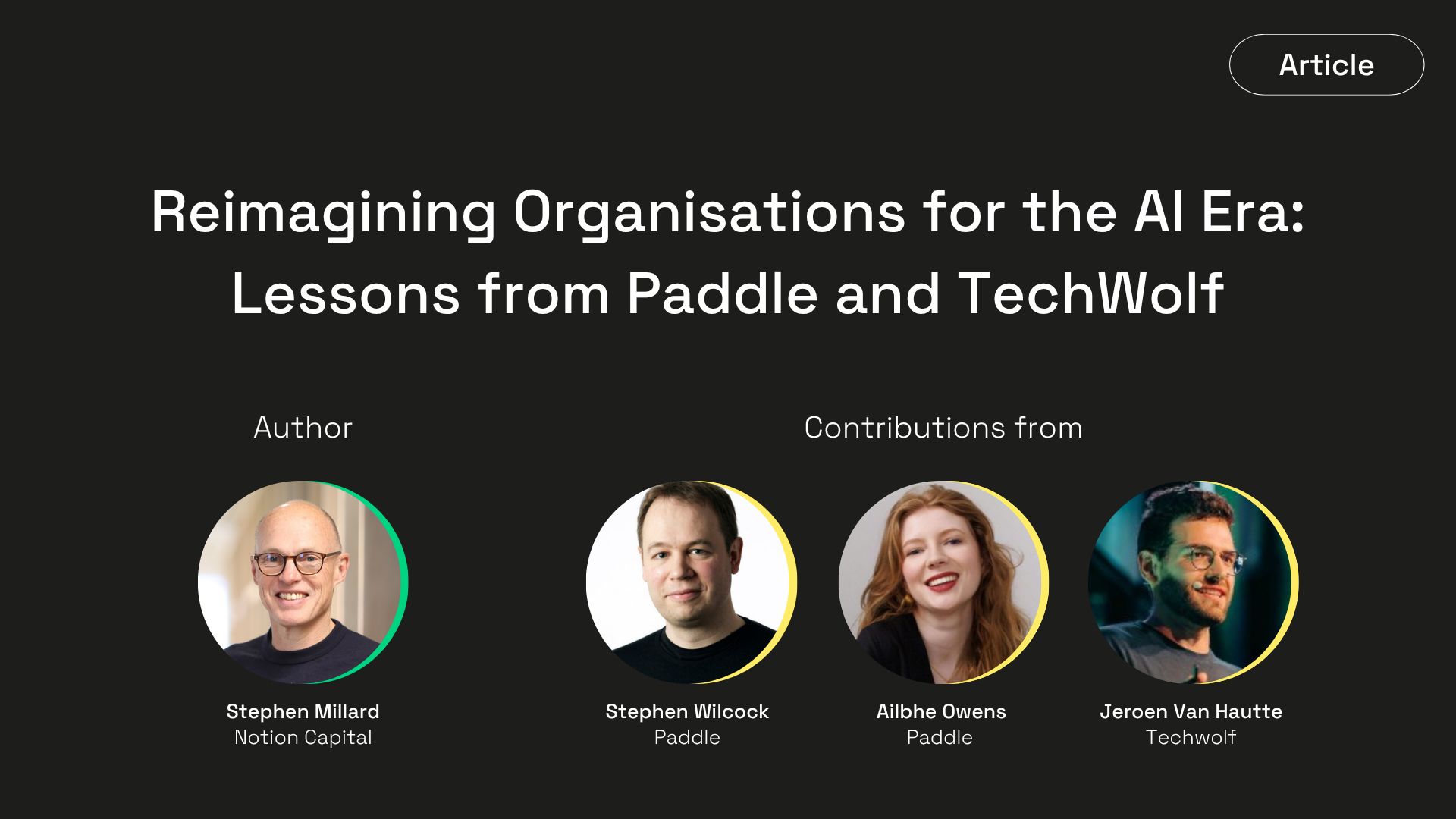
Reimagining Organisations for the AI Era: Lessons from Paddle and TechWolf

Companies exist to create value. Everything else is a means to that end.
The arrival of powerful AI models has changed what is possible inside organisations. Yet while much of the conversation focuses on models, agents and tooling, the harder challenge is organisational.
- How do companies adapt when intelligence becomes dramatically more accessible?
- How do they help people develop new ways of working?
- How do they translate experimentation into meaningful business outcomes?
To explore those questions, Notion Capital recently brought together Stephen Wilcock (CTO, Paddle), Ailbhe Owens (AI Enablement Lead, Paddle) and Jeroen van Hautte (Co-Founder and CTO, TechWolf) for a roundtable discussion on internal AI enablement with leaders from across our portfolio.
While Paddle and TechWolf are approaching the challenge from different starting points, the discussion revealed a common theme. The organisations making the fastest progress are not treating AI as another software tool. They are reimagining how work gets done.
Paddle: From AI Adoption to Workflow Transformation
Paddle's AI journey accelerated in late 2025 when the company decided to treat AI enablement as a strategic initiative rather than a collection of isolated experiments.
The company hired a dedicated AI Enablement Lead, established governance structures, selected a central AI platform and created a framework that balanced experimentation with control.
The results have been significant. Today, Paddle has more than 250 shared agents in production and widespread AI adoption across the business. But perhaps more interesting than the numbers is how the company's focus has evolved.
The initial challenge was adoption, the next challenge is transformation.
As Ailbhe Owens explained, the goal is no longer simply to encourage people to use AI. The focus is increasingly on redesigning workflows, understanding capacity gains and identifying where AI can fundamentally change how work is performed to create better outcomes for both teams and customers.
Rather than viewing AI as a collection of tools, Rather than viewing AI as a collection of tools, Paddle is increasingly viewing it as an operating model, redesigning workflows, decision-making and collaboration to create greater business impact.
Paddle's AI Enablement Journey
Q4 2025
- AI identified as a strategic priority
- Budget and ownership secured
- Governance approach defined
Q1 2026
- AI Enablement Lead hired
- Central AI platform implemented
- Tool integrations established
Q2 2026
- More than 250 shared agents in production
- 100% adoption of AI tooling in engineering
- Responsible AI policy introduced
- Governance committee established
Current focus
- Workflow redesign
- AI-native processes
- Measuring business impact rather than adoption metrics
TechWolf: Building AI Into the Culture
While Paddle's journey has focused on enabling an existing organisation, TechWolf has approached the challenge from a different starting point.
For co-founder and CTO Jeroen van Hautte, AI is not a productivity tool, rather integral to how the company operates.
TechWolf actively positions itself as a place where ambitious people can learn to work with cutting-edge AI tools. AI fluency is embedded within roles and career frameworks, and internal enablement remains a founder-led priority.
One of TechWolf's most important insights is that broad adoption rarely happens all at once.
Rather than trying to convince everyone simultaneously, TechWolf identified employees who were naturally excited about AI, invested heavily in their development and used their success to create momentum across the organisation.
"We first focused on raising the ceiling and then raising the floor," explained van Hautte.
The result was not only greater adoption but stronger internal demand.
How TechWolf Created Internal Momentum
To accelerate adoption, TechWolf:
- Selected eight enthusiastic early adopters
- Ran a two-day AI bootcamp
- Combined theory, guided exercises and a hackathon
- Produced six power users from the initial cohort
- Captured and documented the training
- Turned the programme into self-service onboarding material
Perhaps most importantly, the programme created visible examples of success. Employees could see what was possible, creating internal curiosity and momentum that spread organically.
Lesson One: Raise the Ceiling, Then Raise the Floor
One of the strongest themes from the discussion was the importance of sequencing.
Many organisations attempt to drive company-wide adoption immediately. The instinct is understandable. AI feels urgent and leaders want everyone moving at once.
The experiences of Paddle and TechWolf suggest a different approach.
The first objective is not universal adoption. It is creating examples.
Champions demonstrate what good looks like. They develop practical use cases. They share lessons with colleagues. Most importantly, they prove that meaningful gains are possible.
Only once those examples exist does broader enablement become easier.
The lesson is not to start everywhere.
It is to create visible evidence that new ways of working actually work.
Lesson Two: Governance and Experimentation Must Coexist
A second theme was the tension between control and innovation.
Too much governance slows progress. Too little governance creates risk.
Paddle's answer has been a hybrid model. Governance is centralised, standards are clear and security, compliance and quality remain non-negotiable.
At the same time, experimentation is distributed. Employees are encouraged to identify opportunities, build solutions and share what works.
The objective is to combine broad participation with responsible deployment.
As organisations move beyond prompting and into agentic workflows, automation and AI-assisted decision-making, finding this balance becomes increasingly important.
The companies making the fastest progress are learning to combine governance with experimentation.
Lesson Three: Redesign Workflows, Not Just Tasks
Perhaps the most important lesson from the discussion was that productivity gains alone are not the destination.
Most organisations begin their AI journey by accelerating existing tasks. Reports get written faster, analysis becomes easier and information becomes more accessible.
These improvements matter, but they are only the first step.
The larger opportunity lies in redesigning workflows altogether.
At Paddle, this increasingly means examining processes such as lead qualification, reporting and operational decision-making to determine how AI can reshape workflows, rather than simply accelerating existing tasks.
At TechWolf, it means helping employees develop the skills and habits required to operate effectively in a world where AI becomes a constant collaborator.
The shift is subtle but important.
The question moves from:
"How do we do this task faster?"
to:
"Is this still the right way to do this work?"
Reimagining the Organisation
The experiences of Paddle and TechWolf highlight an important reality.
AI-native startups, scale-ups adapting established processes and incumbents pursuing reinvention may start from different places. But they face a similar challenge.
How do you operate effectively in a world where intelligence is increasingly abundant?
How do you help people develop new capabilities?
How do you create greater value for customers?
The companies making the fastest progress are not simply deploying more AI. They are building capability, creating alignment and rethinking how work gets done to deliver better outcomes.
For many organisations, AI adoption begins with tools. It progresses through experimentation, enablement and workflow redesign.
Over time, however, the questions become broader.
- Which processes still make sense?
- Which assumptions about work still hold true?
- How should teams operate when AI becomes a constant?
Paddle and TechWolf are approaching those questions from different starting points. Yet both illustrate the same underlying shift: the challenge is no longer simply introducing AI into existing ways of working. It is learning how to redesign those ways of working altogether.
Questions for Leaders
As AI capabilities continue to improve, the challenge is no longer simply introducing new tools. It is rethinking how work gets done.
A useful place to start is with a few simple questions:
- Where are we measuring AI adoption when we should be measuring business outcomes?
- Which workflows consume the most time and coordination today?
- If we were designing this process from scratch in a world where AI exists, would it look the same?
- Who are our internal champions and how do we make their success visible?
- Where do we need more experimentation, and where do we need more governance?
The technology will continue to evolve.
The enduring challenge is organisational reimagination.
Similiar
Articles
you also may like to read
Similar
Articles
you also may like to read


Get the latest from Notion Capital. Sign up to our newsletter.
Keep the conversation going:
LinkedIn
