No items found.



Growing pains - juggling complexity
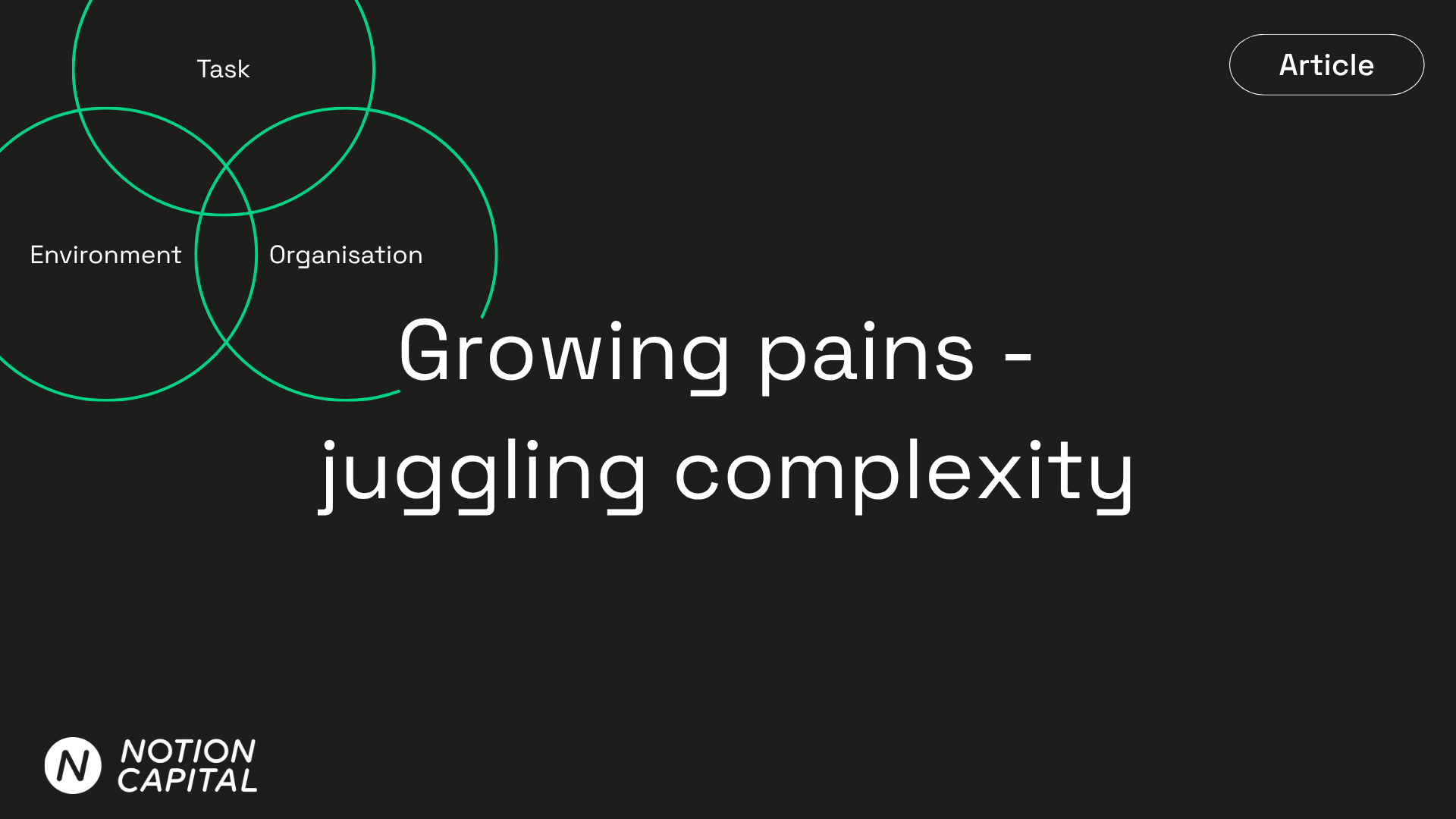

Organisations exist to do things that are bigger and more complex than we can handle alone, so the central job of ‘managing’ a business – any business – is understanding how to handle that complexity. As businesses grow there are three areas of complexity to keep an eye on:
1. The Task – what we’re actually there to do, like building some software
2. The Environment – typically the market and customers
3. The Organisation – the thing that builds the software and interacts with the environment
As businesses grow, each of these changes, but they don’t all change at the same rate or at the same time. Some changes are incremental, some are much bigger step changes and some will be disruptive.
Typically in an early growth technology company, there’s a big step change in Task when you go from MVP to industrial strength product. Complexity then flattens off to something closer to incremental as you progressively augment the core offer with extra features in response to customers’ demands.
Complexity in the Environment can start by increasing incrementally as you progressively add customers, slightly more as you break into new market segments,and a big step change when you go global, or break into the US.
Organisational complexity tends to go in a few big steps with incremental change in-between. You start with a couple of people, a dog and a backroom, cutting code and doing everything including walking the dog. Then there’s a team and the team needs a bit of both team and project management. Then there’s a step change and you’re managing multiple teams that need coordinating and tasking and…. The next step change is to an organisation with a set of departments each of which has teams. Each of those steps is a big shift with new types of management tasks associated with it. And lots of fast growth companies stop growing fast because they try to manage the organisation with departments of teams the same way as they did when it was just half a dozen of you and the dog was still a player.
What this means for you and your teams:
1. Because these move at different rates and because most of us don’t cope well when overloaded by complexity, it's really important to manage the growth so that you’re not facing major change in all three domains at the same time. Which is easier said than done since – of course – they are all linked. When you do the jump properly into the US market, you’re going to have to set up new capability. There’s a good chance that some of that will be stateside, so a new bit of the organisation has to be built out of direct visibility (if you’re in Europe). So change in one domain triggers change in others.
2. Most of this is fairly predictable, not necessarily the timing of a shift, but the nature and scale are mostly predictable. We have reasonably good models for market dynamics and organisational growth stages are fairly predictable; we can work out on a case by case basis the way these things connect. And the tech complexity is home turf for tech companies, even though the indicators of getting it wrong like technical debt are often airbrushed out. So the predictability means we can do the sequencing between the different domains without getting overwhelmed by trying to change everything at once.
3. The start-up community has pretty good models for how to deal with the organisational complexity up to the scale of a team. Beyond that, you really need a different set of models, and need to learn how to use those, because the organisational complexity is every bit as important as the other two and can be just as lethal if you get it wrong and just as helpful if you get it right.
Think of it as juggling - in a three ball juggle, most of the time you only have one ball in the air, the other two are firmly in your hands. There’s a brief moment when two are airborne as you throw a second ball up before catching the one coming down, but the trick is to minimise the number of balls in the air. Same for growing a business.
Similiar
Articles
you also may like to read
Similar
Articles
you also may like to read


Get the latest from Notion Capital. Sign up to our newsletter.
Keep the conversation going:
LinkedIn
